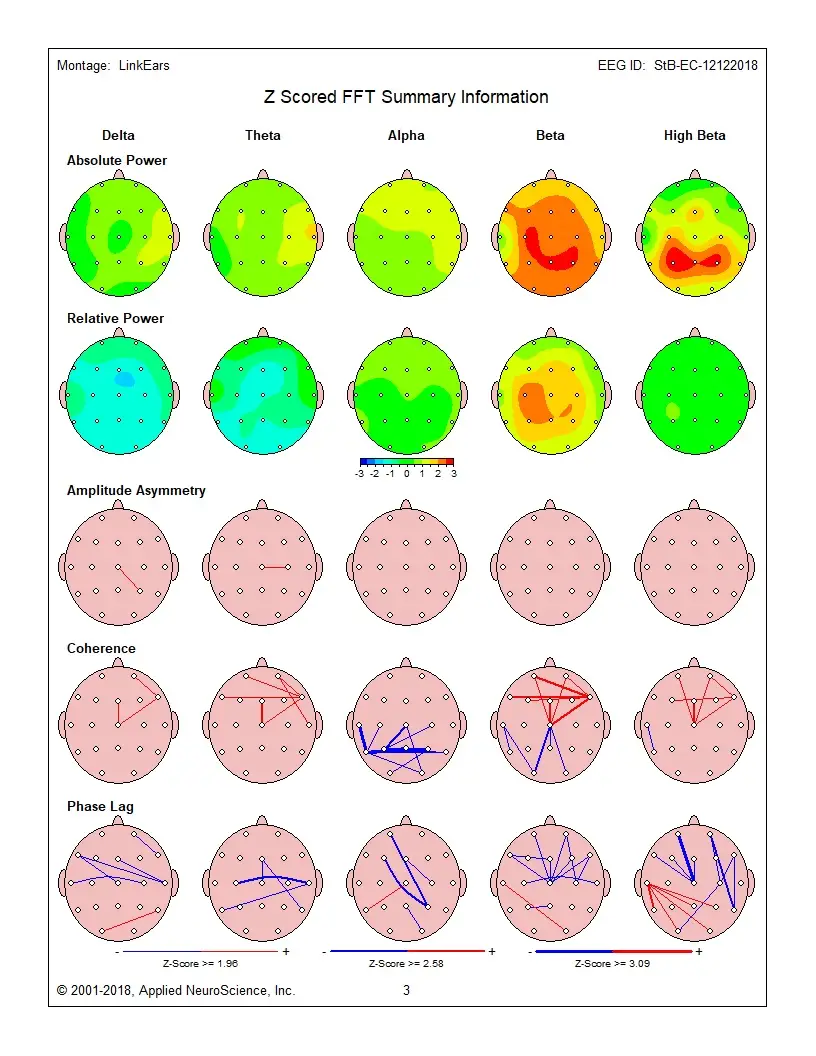
EEG data

Research Papers

Musical neurofeedback for treating depression in elderly people

Ramirez, Rafael, Palencia-Lefler, Manel, Giraldo, Sergio, Vamvakousis, Zacharias (2015) · Frontiers in Neuroscience

We introduce a new neurofeedback approach, which allows users to manipulate expressive parameters in music performances using their emotional state, and we present the results of a pilot clinical experiment applying the approach to alleviate depression in elderly people. Ten adults (9 female and 1 male, mean = 84, SD = 5.8) with normal hearing participated in the neurofeedback study consisting of 10 sessions (2 sessions per week) of 15 min each. EEG data was acquired using the Emotiv EPOC EEG device. In all sessions, subjects were asked to sit in a comfortable chair facing two loudspeakers, to close their eyes, and to avoid moving during the experiment. Participants listened to music pieces preselected according to their music preferences, and were encouraged to increase the loudness and tempo of the pieces, based on their arousal and valence levels. The neurofeedback system was tuned so that increased arousal, computed as beta to alpha activity ratio in the frontal cortex corresponded to increased loudness, and increased valence, computed as relative frontal alpha activity in the right lobe compared to the left lobe, corresponded to increased tempo. Pre and post evaluation of six participants was performed using the BDI depression test, showing an average improvement of 17.2% (1.3) in their BDI scores at the end of the study. In addition, an analysis of the collected EEG data of the participants showed a significant decrease of relative alpha activity in their left frontal lobe (p = 0.00008), which may be interpreted as an improvement of their depression condition.

View Full Paper →

Neurofeedback Efficacy in the Treatment of a 43-Year-Old Female Stroke Victim: A Case Study

Cannon, K.B, Sherlin, Leslie, Lyle, Randall R. (2010) · Journal of Neurotherapy

Introduction. A 43-year-old Caucasian woman presented with a series of physical and mental deficits following a right hemisphere cerebral artery embolus suffered at age 42. Method. For both the pretreatment and posttreatment evaluation, the client's EEG data were collected. Prior to beginning neurofeedback a self-developed symptom checklist was provided to the participant and was repeated every 10 sessions. The participant received 52 neurofeedback sessions with the use of Neurocybernetics equipment. To determine statistical changes between the pretreatment and posttreatment conditions, average cross-spectral matrices were computed for bands delta (1–3.5 Hz), theta (3.5–7.5 Hz), alpha (7.5–12.5 Hz), beta1 (12.5–25 Hz), beta2 (25–32 Hz), and gamma (37–47 Hz). In this study the pretreatment cross-spectra for each epoch were then compared to the posttreatment epoch cross-spectra using the previously mentioned frequency band ranges. For each condition, cross-spectral matrices were computed and averaged over 2-s epochs resulting in one cross-spectral matrix for each epoch and for each of the discrete frequencies within each band. Based on previous LORETA analyses, we used a rectangular window. No time frame or frequency wise normalization was performed. Results. Following treatment, comparative QEEG and eLoreta analyses illustrated significant decreases in the absolute and relative power theta measures and significant elevations of absolute and relative power occipital beta. These findings correspond to client self-report data demonstrating improvement in cognitive functioning and depressed mood. Conclusion. Overall, findings suggest the utility of neurofeedback for the treatment of stroke,with particular gains noted in the areas of cognitive functioning, sleep quality, emotional regulation, and energy.

View Full Paper →

Ready to Optimize Your Brain?

Schedule a free consultation to discuss eeg data and how neurofeedback training can help

* Required fields